Three problems, three approaches
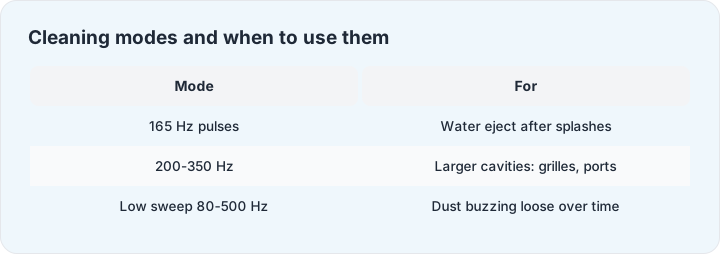
Speakers lose clarity for three different reasons, and each responds to a different treatment. Water sits in the cavity and muffles everything — the 165 Hz pulsed sequence above moves it out in seconds. Dust and debris is slower: particles rest on the driver or lodge in the mesh, producing a persistent buzz on bass notes; low sweeps from 80 to 500 Hz vibrate them loose over a few runs. Mesh blockage — the fine screen under the grille — responds partially to vibration, but often wants a soft brush afterward; our muffled sound guide covers the physical cleaning steps.
The mode selector switches between pulsed sequences (best for water) and continuous tones (best for dust). For dust cleaning, run the low sweep three or four times over a few minutes — a single pass rarely buzzes a stubborn particle free. Keep the speaker facing down for both, so gravity carries whatever comes loose out of the cavity rather than deeper in.

How to tell cleaning worked
Before you start, play one reference sound and remember it — a bass-heavy track or the low sweep itself works. After cleaning, compare. Success sounds like this: the buzz on bass notes gone, maximum volume noticeably louder, or the underwater muffle replaced by clear highs. If nothing changed after three runs and a gentle brushing, the problem is probably not debris — check the cause table for case interference and software EQ, the two impostors that pretend to be dirty speakers. And when a driver buzzes at all volumes with no debris to find, that is hardware failure — the repair decision guide runs the numbers on fixing versus replacing.