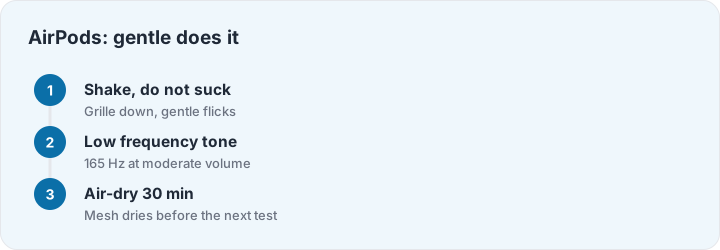
Why AirPods are different from phones
A phone speaker is a robust driver behind an open grille; an earbud is a tiny precision driver behind an acoustic mesh, sealed with glue that softens with heat. That changes the playbook completely. The aggressive moves that are harmless on a phone — loud tones, strong shaking, sucking the water out — are exactly the moves that damage earbuds. Suction is the worst offender: it pops the delicate membrane inward and can end an earbud instantly.
The gentle routine that works: hold the wet earbud with the mesh facing down and give it soft, quick flicks — like flicking water off a thermometer, not shaking a cocktail. Then play a low tone at moderate volume (165 Hz is fine; the sequence above works) for one or two runs to vibrate residual droplets off the mesh from the inside. Finish with air time: thirty minutes mesh-down on a dry cloth before the next sound check. Most splash-exposed AirPods recover fully with exactly this much.
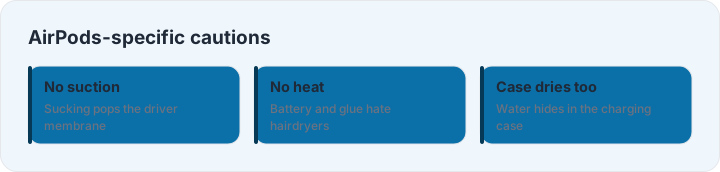
The case is part of the problem
Water that gets past the earbud nozzles often ends up in the charging case, where it sits against the earbuds’ stems and slowly re-wets them. After any water incident, open the case, take the earbuds out, and leave the lid open next to them on a dry towel for a few hours. If you charge wet earbuds in a wet case, you are testing the contacts’ corrosion resistance — the failure mode here is subtle and shows up weeks later as flaky charging. And a caution that saves many earbuds: no hairdryers, no radiators, no pockets-of-salt — room-temperature airflow and patience are the only drying methods that do not add risk. If sound stays muffled or buzzes after a fully dry day, the muffled sound guide helps separate mesh residue from driver damage, and the repair decision guide runs the replacement math for earbuds, which is a different equation than phones.